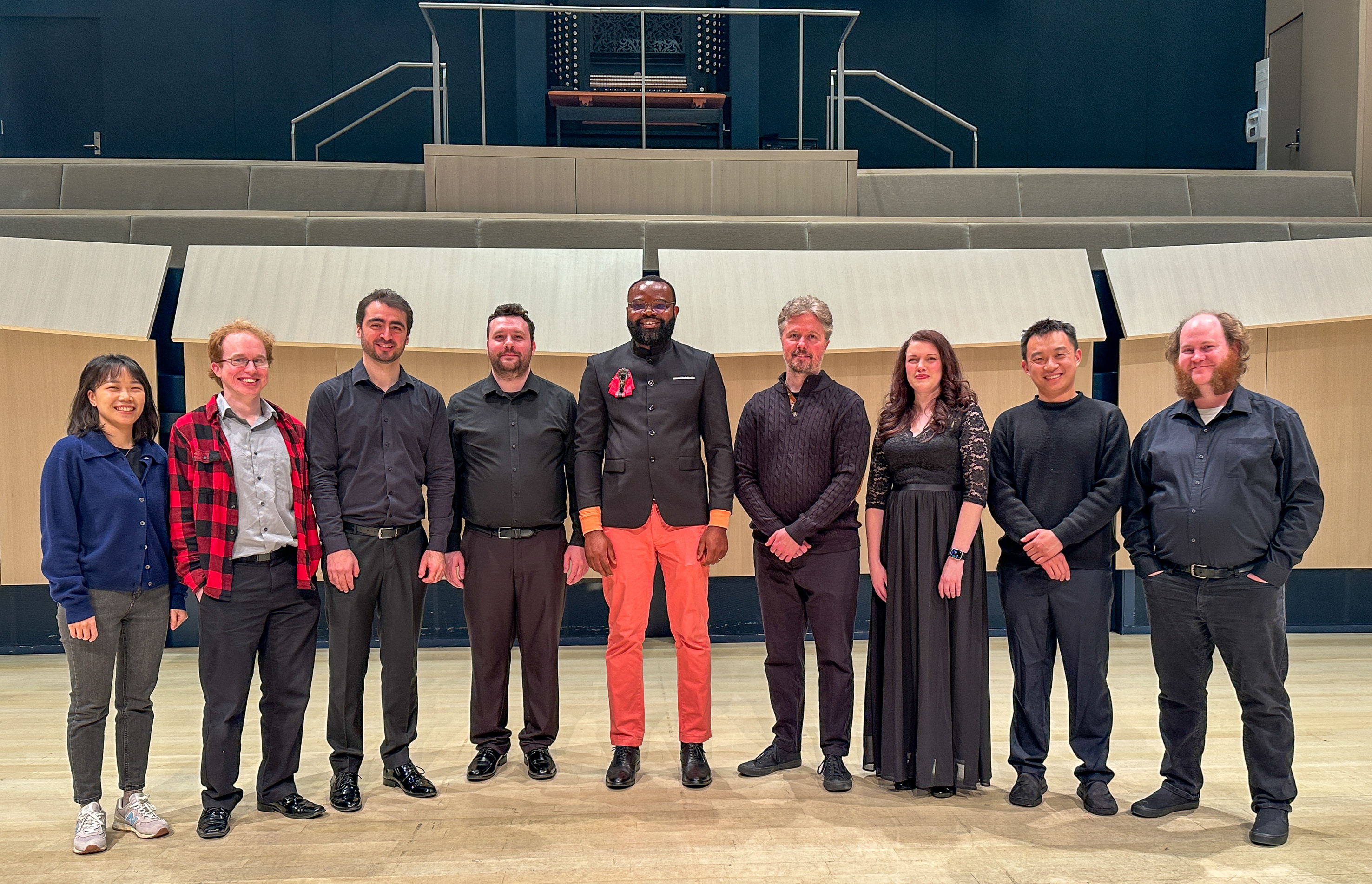
Composers Workshop III
Sunday, March 1, 2026 at 7:30p in the Concert Hall
Program
Nunc Dimittis for Solo Organ | Innocent OKECHUKWU (b. 1988) |
David Devine, organ
Nunc Dimittis takes its name from the ancient canticle of Simeon, whose words; “Lord, now let your servant depart in peace”.....have been set to music by countless composers over the centuries. This organ work offers a contemporary reflection on those timeless sentiments of release, fullfilment, and spiritual serenity.
The piece unfolds in several contrasting sections, each exploring a different facet of the text’s meaning. Mysterious, suspended harmonies evoke the uncertainty of waiting, while owing lines and luminous chordal textures suggest a gradual awakening to peace. Dynamic contrasts build a sense of inner struggle before resolving into radiant calm. Written for the organ’s wide expressive palette, Nunc Dimittis blends traditional liturgical solemnity with modern harmonic language. It invites the listener on a journey from darkness to light, tension to resolution, echoing Simeon’s prayerful acceptance and the universal human longing for transcendence. At its heart, this work is both deeply personal and communal; a musical offering for contemplation, reflection, and hope.
Pipes | Innocent OKECHUKWU |
Ryan A. MacDonald, bass flute
Pipes for solo bass flute treats the instrument as a vessel for breath and resonance rather than a strictly melodic voice. Sustained tones, glissandi, key clicks, air sounds, and subtle vocalizations merge to suggest wind coursing through hollow spaces—organic, raw, and mutable. Guided by rubato and flexible pacing, the performer shapes the music through timbre and breath, allowing sound color and physical gesture to drive the work’s expressive arc.
Metasonic I & II | Innocent OKECHUKWU |
Yestyn Griffith, violin
Metasonic I & II explores the violin as a physical source of sound rather than a purely lyrical instrument. Through extreme bow pressure, sul ponticello textures, percussive effects, and volatile tempo shifts, the work moves between meditative stillness and impassioned intensity. Sound is treated as energy and gesture, blurring the boundary between pitch and noise while inviting listeners into an intensified sonic space.
Eze Kwesili | Innocent OKECHUKWU |
Haziel Candio de Silva Santos, violoncello
Sayyod Mirzomruodov, bass clarinet
Eze Kwesili, translated loosely from Igbo as “One who is fit to be a King” or “the steadfast monarch,” is a musical meditation on resilience, dignity, and inner fortitude. Scored for the strikingly intimate pairing of bass clarinet and cello, the work unfolds as a dialogue between two timbres that share a natural darkness yet possess remarkably different expressive identities.
From the opening Andante, the bass clarinet and cello trade sighing, speech-like gestures that evoke the cadence of Igbo chant. The melodic lines are narrow, fluid, and often ornamented, creating the sensation of a shared breath between the instruments. As the piece develops, the texture becomes increasingly intricate: persistent rhythmic cells in the bass clarinet collide with the cello’s shifting arco and pizzicato patterns, generating a sense of controlled restlessness. These exchanges mirror the thematic core of the work’s steadfastness in the face of subtle but constant change.
As the music unfolds, sharper gestures, pizzicatos, and glissandi introduce a sense of tension and determination. The closing section returns to a more reflective tone, uniting the instruments in a warm, resonant sonority that embodies the dignity and resolve at the heart of the work.
Insomnia | Innocent OKECHUKWU |
Ryan Bell, double bass
Jiachen Tang, piano
Most nights begin the same: I lie down, close my eyes, and wait. Sleep hovers just out of reach, minutes stretch, thoughts loop, and my body feels both heavy and restless. Insomnia traces that private, stubborn journey through the small hours, turning the bedroom’s hush into sound.
The double bass becomes the body’s narrator, breath and pulse, moving between glassy harmonics, whispered arco lines, and dry, clock-like pizzicati. The piano flickers like a bedside light and a mind that won’t power down: short patterns bead into longer chains, then dissolve. At the center comes a sudden rupture: the moment I finally drift off and my body jerks awake, the hypnic twitch that snaps the thread. The music swerves into a sharper, agitated current before emptying back into the uneasy quiet that began it, a cycle resetting itself. You’ll hear that looped arc in the score’s character cues - “Indecisive,” a jolt of “Subito Agitated,” and a return to “Wandering”; as the same ideas reappear with altered shadows.
When Her Name is Called | Innocent OKECHUKWU |
Wendi Griffiths, soprano
John Thomas Morris III, piano
When Her Name is Called sets a poem of invocation, resilience, and collective affirmation. The text unfolds as a series of images that elevate an unnamed woman into a symbol of endurance: the earth leaning closer, dust remembering her footsteps, dawn returning, rivers refusing to forget their source. These metaphors frame her life not as an isolated struggle but as part of a larger, natural continuity—persistent, cyclical, and unextinguishable.
Concerning the text: On January 22, 2026, a friend of mine—a countertenor based in New York- sent me a long lyric and asked whether I might set it as an art song for him. I promised to do so when time allowed, and a few weeks later, I began the project. After completing the piece, I asked about the identity of the lyricist so that proper credit could be included in the score. To my surprise, he explained that the text had been generated by ChatGPT. The experience underscored the remarkable ways in which contemporary technology can produce language of striking poetic resonance, inspiring new musical responses and creative collaborations.
Modal Triptych | Danyun Zhao (b. 1993) |
Chris Mendez, violoncello
Sayyod Mirzomurodov, clarinet
Modal Triptych is a three-movement work shaped by modal writing. The piece treats the diatonic modes as structural resources, focusing on how a mode’s intervallic profile and tonal center can guide melodic direction and harmonic choice, as well as how different modal regions can be integrated through gradual, unobtrusive transitions. Without aiming to evoke a specific historical style, the work draws on modal clarity and non-functional tension to project a sense of space and imagery.