CNM Ensemble Concert III
Sunday, February 22, 2026 at 7:30p in the Concert Hall
David Gompper, director
Samuel Chen, conductor
Program
Boone for chamber orchestra (2025) | Jason WISE(b. 2001) |
Christian Park for fifteen musicians (2026) | Lucy SHIRLEY(b. 1997) |
intermission
Donnaeko for sinfonietta orchestra (2026) | Sanggeun CHOI(b. 1987) |
Sutter Buttes Theft in Variations for sinfonietta (2026) | Kevin SWENSON(b. 1995) |
Center for New Music Ensemble
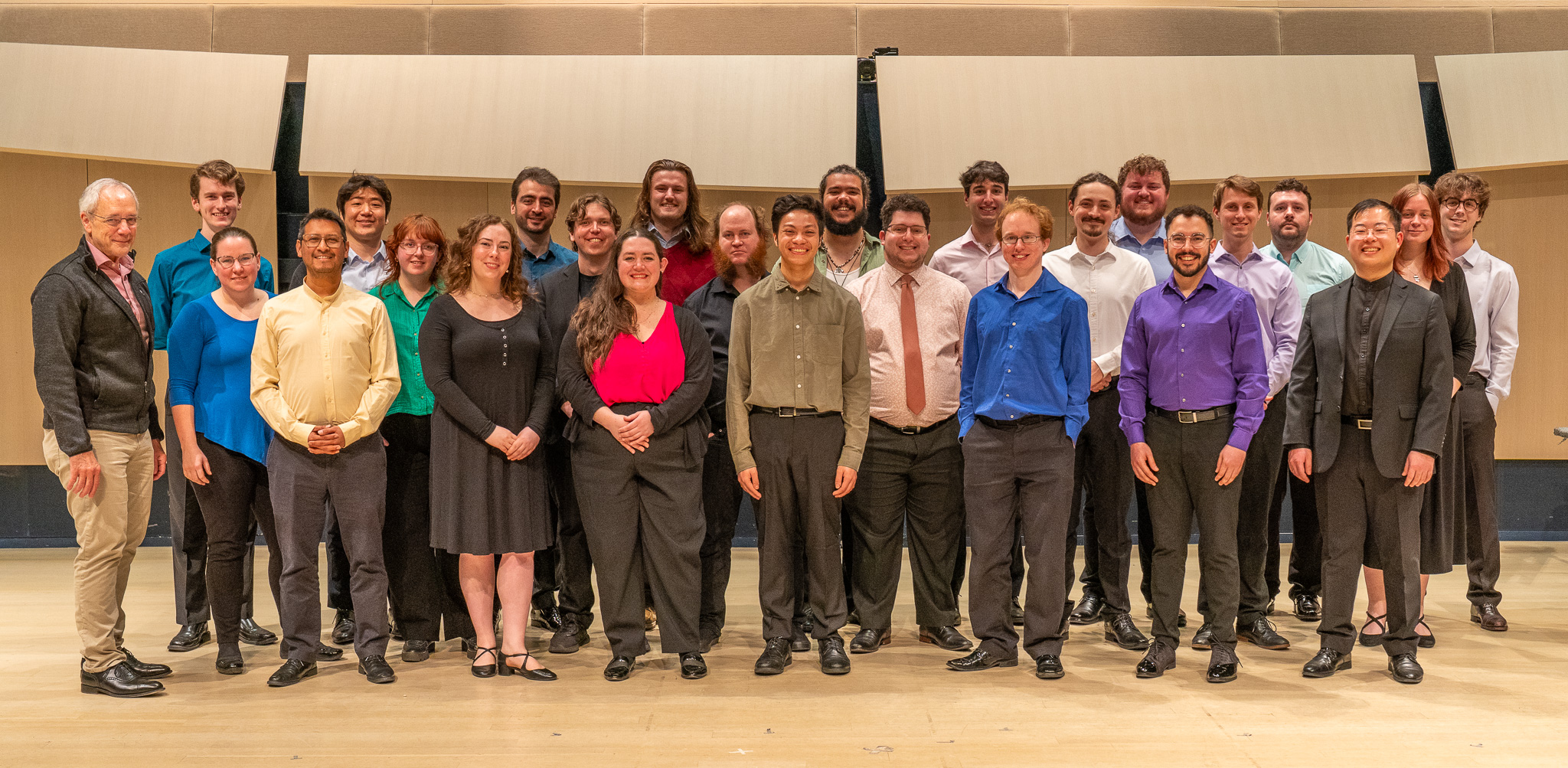
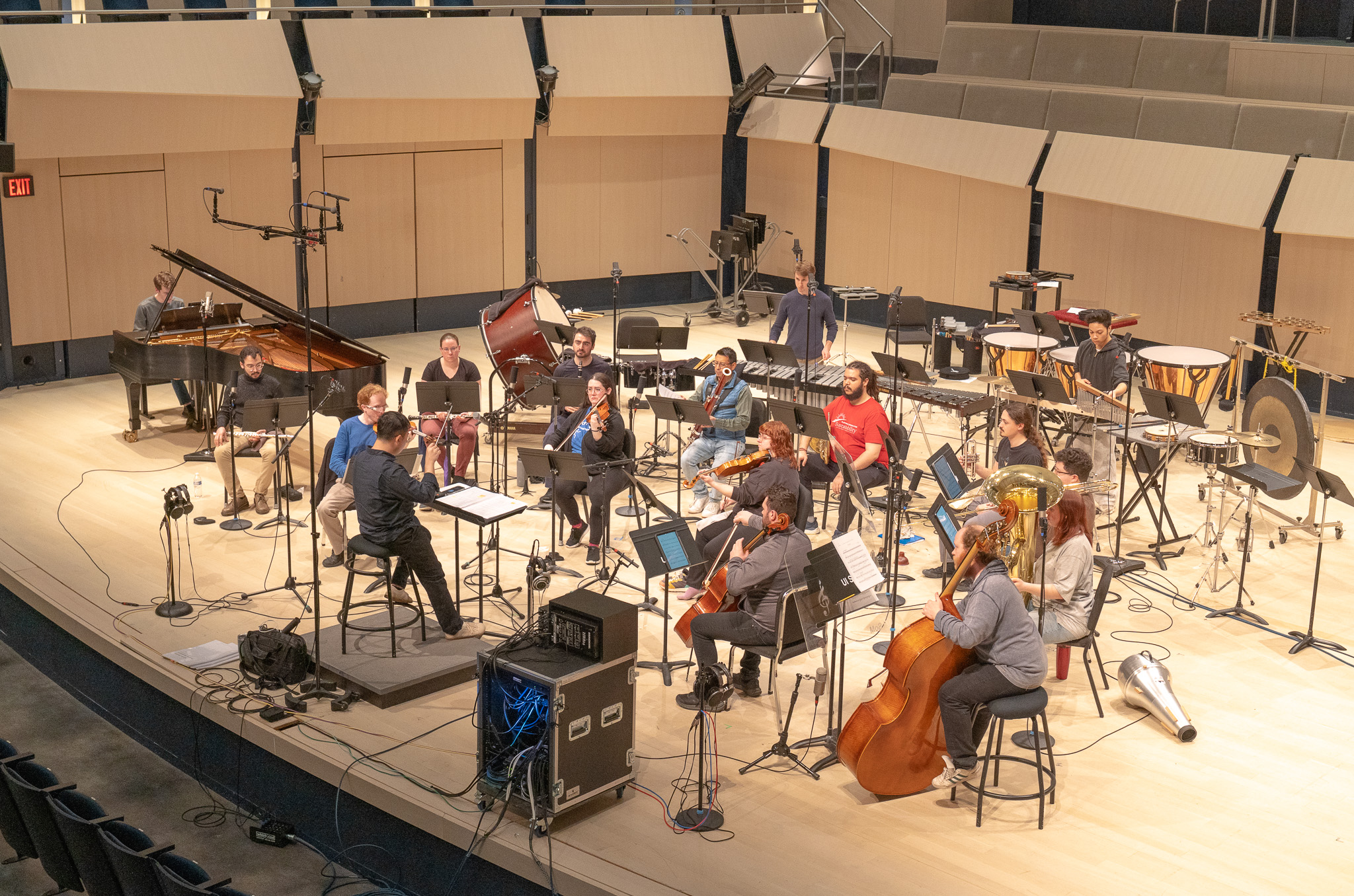
| Caleb Estrada-Valentín, flute1&3 Chaosupei Gao, flute2&4 Felisha Jones, oboe Sayyod Mirzomurodov, clarinet Erik J Lopez Reyes, bassoon Matheus Silva De Souza, horn Josh Levy, trumpet2&4 Ignacio Perez, trumpet1&3 Omar Elmusa, trombone Elly Kern, tuba1,3&4 John T Morris, piano Miles Bohlman, percussion2&4 Evan Tanner, percussion1,2,3,4 Marcus Truong, percussion1&3 Yestyn Griffith, violin I Hugo Kaut, violin II2&4 Rachel Walter, violin II1&3 Kylie Little, viola Chris Mendez, violoncello Ryan Bell, double bass Samuel Chen, conductor |
Program Notes
| This evening’s program features world premieres by University of Iowa composers commissioned by Samuel Chen for his DMA Orchestral Conducting recording project with the Center for New Music. The compositions explore locations of nature with personal significance to the composers. |
| Samuel Chen serves as Instructional Assistant Professor of Orchestras at Illinois State University where he directs and conducts the Illinois State University Symphony Orchestra and Philharmonia String Orchestra. He is also Music Director of Sinfonietta Honolulu, an ensemble he co-founded that focuses on historically informed performance practice of the classical style. He has served as Director for Campus Symphony Orchestra and Assistant Conductor for Symphony Orchestra, the Center for New Music, and conducted opera productions of Mozart’s Così fan tutte and Mascagni’s L’amico Fritz at the University of Iowa. Samuel was appointed as lecturer and sabbatical replacement at the University of Hawaii and has appeared as guest conductor and clinician for the Northern Valley Youth Orchestras in Grand Forks, North Dakota, and Guest Artist-in-Residence with the Concordia Orchestras at Concordia College in Moorhead, Minnesota. He also served as Assistant Music Director for the Lutheran Church of Honolulu where he conducted Rutter’s Requiem and Vivaldi’s Magnificat and Gloria. As a pianist and violinist, Samuel holds degrees in piano performance from the University of Hawaii at Mānoa and has performed chamber and orchestral works at the Monteux School and Music Festival and PRISMA Festival. He was invited to the Cabrillo Festival of Contemporary Music as conducting associate and the Domaine Forget de Charlevoix Conducting Academy. Samuel’s doctoral recording project consists of commissions from Iowa composers featuring compositions inspired by nature incorporating extended techniques for undergraduate small ensemble. His principal mentors include Thomas Yee, Joseph Stepec, Kevin Sütterlin, David Gompper, Wayne Wyman, and Kenny Lee. |
| Boone is a composition named after my college town in North Carolina. During the 4 years I lived in Boone attending Appalachian State University, I grew to love and cherish the area like a second home. Located in a valley in the Appalachian mountains, Boone represented everything great in life for me. I made many friends, enjoyed nature, and experienced all kinds of new things. This work can be viewed in two ways; one being the physical descent down from the peaceful mountains into the busy town, and the other being an auditory journey of the town's progress from being quiet and small to overcrowded and alienated. I think both stories are effective through the music and share equal importance to me. While I tend to compose music that follows a story such as a descent into the valley, it is nice to express a more important issue like the effect of universities on small towns. In a place such as Boone, it can sometimes feel like locals versus college kids. The same can be expressed for the University of Iowa where I went to school as well. Iowa City is not quite the same without the University of Iowa for better or worse. The constant build in my composition represents this push for success and growth as an institution in a town that as a result affects the folk who have lived there their whole life. |
| Jason Wise (b. 2001) is a composer, trombonist, and artist from North Carolina. Wise studied at Appalachian State University (BA) and the University of Iowa (MA) for composition. He has collaborated with musical groups such as the Brevard Music Festival, the International Trombone Festival, the JACK quartet, and Canadian Brass. While he has a strong connection to brass writing, Wise has also written large ensemble pieces for wind band and orchestra and various other chamber groups. Wise composes electronic music, blending the world of popular music, electronic music, and classical style together. He has a love for movies and sees his compositions as scores, painting a story or simply capturing the setting of a piece. |
| Christian Park is about memory, cycles, and reconstructing the way we view the world. The piece takes its name from a park in my hometown of Indianapolis, Indiana. The park is nestled in the middle of the city, with paved sidewalks winding past clusters of forest, over a rickety bridge, and circling an old gazebo set far back in the grass. I went there a lot growing up, and it’s the place where I first learned to ride my bike. I haven’t been back since I was young, so the whole nature-scape is recreated through memory, which is important in the concept of the piece itself: I wanted my memory to serve as a buffer between the park itself and my music about it. The piece is quasi-programmatic, depicting a slow-motion picture of a single moment in which I rode my bicycle for the first time without training wheels. My whole family was there: my mom, dad, and brother, cheering me on. Since then, the structure of my family has changed, and I'm wondering if, by revisiting that memory with the knowledge I have now, I can see the cracks in the pavement already forming, almost as if I can make sense of the way life turns out from that single moment. At the beginning, the sound-world is open and is slowly building up a landscape note by note, all on white keys, like you’re just learning your first notes on the piano when you’re a kid. You can hear birdsong, a bicycle bell, and the creaking wood in the percussion; there are these repeated cycles of swirling melodic figures, these spinning wheels over hills and valleys. Everything is consonant until an F# appears, which is almost like the "wound" of the piece, just under the surface. The F# breaks through the constructed landscape until we’re so far away from any semblance of where we started, constantly swirling through fragmented sounds. When things break apart, you can hear the percussion representing harsh cracks and granules of gravel and broken pavement. Once there’s finally a return of the opening material, it’s a memory that's a half-step away from the beginning. The climax of the piece exists at once in both the past and the present, merging what I knew then with what I know now, still pedaling on. There's finally a feeling that the F# from the beginning belongs in the new harmonic world, as if healing that original wound. But of course, nothing stays wonderful forever. The F-natural comes back and creates new tension. And you just kind of have to live with that. It’s still beautiful, and more so for going through the journey. Many thanks to Sam Chen for commissioning this work, and to David Gompper and the Center for New Music musicians at the University of Iowa for their dedication in performing it. |
| Lucy Shirley is a composer interested in language and memory. Her works are polystylistic and playful, often focusing on aspects of the human voice. Shirley’s earliest musical influences come from long car rides as a kid listening to her mom’s mixtapes of showtunes and classic Americana, and she frequently finds herself incorporating aspects of theatricality and folk melody into her current practice. She has worked with artists such as JACK Quartet, the mdi ensemble, LIGAMENT, The Crossing, The Imani Winds, Mammoth Trio, and Carrie Koffman, and her music has been featured at festivals such as June in Buffalo, the Norfolk New Music Workshop, the Napoleon Electronic Music Festival, the World Saxophone Congress, the University of Georgia's New Music Festival, and HighSCORE Festival in Pavia, Italy. Shirley’s awards include selection in IAWM’s 2024 Call for Scores, SOLI Chamber Ensemble’s 30x30x30 Project, and a 2022 ASCAP Morton Gould Young Composer Award. |
| Donnaeko - This orchestral work is inspired by a place that remains vivid in my memory—Donneko Valley in Jeju. A summer spent there left strong impressions, not only of the valley’s changing natural scenes from day to night, but also of how those experiences gradually entered my inner world and became part of my personal memory. Early on, the music evokes the liveliness and motion of the valley in daylight, with sounds that suggest shifting light, gentle breezes, and a quiet sense of life moving through the space. As night arrives, the atmosphere grows darker and more spacious, tracing the quiet shifting of light and shadow and settling into a calm state where stillness and subtle motion exist together. As the music continues, these outward impressions turn inward. Brief melodic fragments, reminiscent of my childhood memories and songs from my hometown, appear and fade like passing traces of memory. In this space, the early sensations of day and night blend naturally with personal reflection, where the physical experience of the place to quietly resonate with a sense of origin and identity. |
| Sanggeun Choi is a Korean composer and music arranger whose work bridges non-Western philosophical thought and traditional aesthetics with Western art music. His music explores the expressive potential of global traditional instruments, creating innovative sonic landscapes that connect cultural narratives and foster cross-cultural dialogue. Specializing in orchestral music, Choi’s orchestrations were featured at national ceremonies and state banquets during his tenure with the Korean National Police Orchestra, including performances at the Blue House, the official presidential residence of South Korea. His works have been performed in the United Kingdom, China, Oman, and major cities in the United States, including Boston, New York, and Chicago. One of his representative orchestral works, Arirang Fantasy, was presented as part of the BuzzBeat Project at the Vibration for Visualized Sound concert in the United Kingdom in 2018, and later performed in 2022 during the 30th Anniversary Commemoration of Korea–China Diplomatic Relations in China. Choi holds a master’s degree in music composition from the Mannes School of Music at The New School and is currently a PhD candidate in composition at the University of Iowa. His doctoral research examines the intersection of Eastern philosophy and contemporary orchestral expression. |
| Sutter Buttes Theft in Variations - Although they are the smallest mountain chain in the world, the Sutter Buttes loomed large over the horizon of Yuba City when I was growing up. The materials for this piece are inspired by and derived from the contour of the Buttes. With help from my mentor, Dr. Jean-François Charles, I made a program that extracted the contour of the mountain from a still photograph. After compressing the data, I algorithmically generated a melody that follows the contour of the mountain. This melody is heard throughout the piece in many different textures and guises. Similar algorithmic manipulations were used to create a series of tempi, rhythmic patterns, and even a series of meter changes. The obvious part of the piece’s title refers to this process. But why Sutter Buttes Theft in Variations? The theft comes in two ways. From one perspective, the melodic and harmonic material is “stolen” from the Sutter Buttes. More deviously, however, I stole directly from several famous pieces by composers of the past. For example, the piece’s dark opening is modeled directly on the introduction of Bartok’s Concerto for Orchestra; the dance-like section that follows it is modeled on the “Coda” movement from Stravinsky’s Agon; later in the piece there is a section that juxtaposes a quote from Mendelssohn’s Hebrides Overture with relentless, dissonant chords inspired by The Rite of Spring; there is also a minimalist section inspired by an ostinato figure in Dalbavie’s Palimpseste. Between these moments of theft are sections of entirely original material. Together they ebb and flow up and down from intensity to stasis, just like the setting sun backlighting the contour of the Sutter Buttes. |
| Kevin Swenson is a composer and performer of acoustic and electronic music from Yuba City, California. His recent work explores musical materials derived through diverse techniques such as digital image processing, fractal geometry, Pythagorean numerology, and just intonation tuning. His compositions have been featured in music festivals throughout the US including the PdMaxCon25~ conference, University of Oklahoma’s inner sOUndscapes concert series, the Napoleon Electronic Music Festival, the Splice Institute, the Cazenovia Counterpoint Festival, and the 28/78 New Music Festival, as well as at the KlexosLab New Music Festival in Spain. He also gave a presentation about his ongoing computational music theory project involving Stravinsky’s serial period music at the 18th International Conference on Music Perception and Cognition in São Paulo Brazil in the Summer of 2025. He is currently an ABD Ph.D. Candidate in Music Composition at the University of Iowa. In addition to his studies, he works as the Audio Lab Teaching Assistant for Iowa’s Department of Dance. |