CNM Ensemble Concert IV

Sunday, April 19, 2026 at 7:30p in the Concert Hall

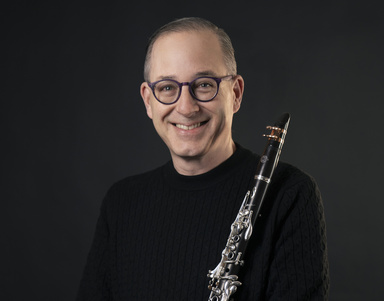
featuring guest clarinetist
Michael Norsworthy
and guest composer
Pierre Jalbert

Program

Star Box for percussion quartet (2020)

Augusta Read THOMAS (b. 1964)

Miles Bohlman, Evan Tanner, Shaun Everson, Ava Chopskie 
 

Equilibrium for clarinet and string quartet (2024)

Pierre JALBERT (b. 1967)

Michael Norsworthy, clarinet
Yestyn Griffith, violin 1
Rachel Walter, violin 2
Kylie Little, viola
Christopher Mendez, violoncello 
 

intermission

Concerto for clarinet and chamber group (1954)

Ralph SHAPEY (1921-2002)

Michael Norsworthy, clarinet
Jacob White, horn
Miles Bohlman & Evan Tanner, percussion
John T Morris, piano
Yestyn Griffith, violin
Christopher Mendez, violoncello
David Gompper, conductor
 

All is Now, for 10 players (2021)

Pierre JALBERT

Chaosupei Gao, flute
Sayyod Mirzomurodov, clarinet
Jacob White, horn
Elena Brisch & Eli Priebe, percussion
John T Morris, piano
Yestyn Griffith, violin 1
Rachel Walter, violin 2
Kylie Little, viola
Christopher Mendez, violoncello
Ryan Bell, double bass
David Gompper, conductor
 

Performer biography

 
Michael Norsworthy, clarinet

Grammy award winner, Michael Norsworthy, has been heard in major concert halls around the globe and is a recognized educator, technician and consultant. His personal approach to presenting, developing and nurturing the artistic possibilities around him have resulted in partnerships with world class musical collaborators, schools of music and manufacturers. As soloist with numerous orchestras around the USA and abroad, as a captivating recitalist and chamber music performer and as one of the most celebrated champions of the modern repertoire having premiered over 150 new works at such venues as Carnegie Hall, Vienna’s Musikverein, Moscow’s Tchaikovsky Hall, The Casals Festival and the Aspen Festival, Norsworthy has defied categorization, dazzling critics and audiences alike.  His discography, numbering over 80 releases, can he heard on Naxos, Mode, Gasparo, Albany, New Focus, New World, BMOP/sound, ECM, Navona, Nonesuch, Canteloupe and Cauchemar records. He is the owner of New York City Woodwinds and is a proud performing artist for Selmer Paris and Vandoren.


Program Notes 

Augusta Read Thomas (b. 1964)
Star Box for percussion quartet (2020)
    Music for me is an embrace of the world – a way to open myself up to being alive in the world in my body, in my sounds, and in my mind. I care deeply about musicality, imagination, craft, clarity, dimensionality, an elegant balance between material and form, and empathy with the performing musicians.
     My works always spark and catch fire from spontaneous improvisations. It is music always in the act of becoming. I have a vivid sense that the process of the creative journey (rather than a predictable fixed point of arrival) is the essence. Poetry can give language to the ineffable. Music is, in an analogous way, akin to an infinite alphabet. Sounds can become like butterflies, hummingbirds, lights, rocks, trees, webs, gardens, and landscapes. Organic and, at every level, concerned with transformations and connections, the carefully sculpted and fashioned musical materials of Star Box are nuanced, agile and spirited, and their flexibility allows pathways to braid harmonic, rhythmic, and contrapuntal elements that are constantly transformed —at times at times jazzy, at times groove-like, at times layered and reverberating.
     Across Star Box’s 6-minute and 30 second duration, the ensemble unfolds a labyrinth of musical interrelationships and connections that showcase the four musicians in a virtuosic display of rhythmic agility, counterpoint, skill, energy, dynamic and articulative range, precision, and teamwork. Throughout the kaleidoscopic journey, the work passes through various lively and colorful episodes, which propel the musical discourse always amid a sense of pirouettes, fulcrum points, and effervescence.
     Following a long and rich tradition of composers who wrote for percussion (Edgard Varèse, Harry Partch, John Cage, and Lou Harrison) over the past 30 years, I have composed extensively for percussion designing works including: a concerto for percussion quartet and orchestra, a percussion quartet playing bells from all around the world, 2 other percussion quartets, solos, and two octets for percussion and string quartet. Additionally, many of my 65 orchestral works feature percussion.
     Star Box is to be performed with dancers when feasible and was commissioned by the Kaleidoscope Chamber Orchestra. Commissioning new art is a leap of faith, and as such, artists must always be deeply grateful to those who support the creation and realization of their life's work. I feel profoundly fortunate for the investments made by the Kaleidoscope Chamber Orchestra, and I devoted my strongest, most focused efforts to composing Star Box in memoriam of my Yale University teacher, Jacob Druckman.
     Music’s eternal quality is its capacity for change, transformation, and renewal. No one composer, musical style, school of thought, technical practice, or historical period can claim a monopoly on music’s truths. I believe music feeds our souls. Unbreakable is the power of art to build community. Humanity has and will always work together to further music’s flexible, diverse capacity and innate power.— Augusta Read Thomas

     The music of Augusta Read Thomas (b. 1964 in New York) is nuanced, majestic, elegant, capricious, lyrical, and colorful — "it is boldly considered music that celebrates the sound of the instruments and reaffirms the vitality of orchestral music" (Philadelphia Inquirer).
     A composer featured on a Grammy winning CD by Chanticleer and Pulitzer Prize finalist, Thomas’ impressive body of works “embodies unbridled passion and fierce poetry” (American Academy of Arts and Letters). The New Yorker magazine called her "a true virtuoso composer." Championed by such luminaries as Barenboim, Rostropovich, Boulez, Eschenbach, Salonen, Maazel, Ozawa, and Knussen, she rose early to the top of her profession. The American Academy of Arts and Letters described Thomas as “one of the most recognizable and widely loved figures in American Music."
     She is a University Professor of Composition in Music and the College at The University of Chicago. Thomas was the longest-serving Mead Composer-in-Residence with the Chicago Symphony Orchestra for conductors Daniel Barenboim and Pierre Boulez (1997-2006). Thomas won the Ernst von Siemens Music Prize, among many other coveted awards. She is a member of the American Academy of Arts and Sciences, and a member of the American Academy of Arts and Letters. Thomas was named the 2016 Chicagoan of the Year.
     Recent and upcoming commissions include those from the Santa Fe Opera in collaboration with the San Francisco Opera and other opera companies, PEAK Performances at Montclair State University and the Martha Graham Dance Company, The Cathedral Choral Society of Washington D.C., The Indianapolis Symphony, Tanglewood, The Kaleidoscope Chamber Orchestra, Des Moines Symphony, Boston Symphony, the Utah Symphony, Wigmore Hall in London, JACK quartet, Third Coast Percussion, Spektral Quartet, Chicago Philharmonic, Eugene Symphony, the Danish Chamber Players, Notre Dame University, Janet Sung, Lorelei Vocal Ensemble, and the Fromm Foundation. 


Pierre Jalbert (b. 1967)
Equilibrium for clarinet and string quartet (2024)
     The word equilibrium implies balance.  It seems to me that the world, especially recently, is careening towards being very unbalanced and out of sorts.  From climate change to politics, extremes seem to rule the day.  This work focuses on the striving for a sense of equilibrium and is in three contrasting movements.  The first movement, Still/Animate, seeks to balance two types of music: the first, static and calm, and the second, rhythmically active.  The back and forth between the two, and the proportion of each, results in a kind of conversation through form.  The second movement, Chant, uses Gregorian chant as its basis, but expands and weaves the lines into a more contemporary texture.  The third movement, Tipping Point, is fast-paced and at times frantic, always pushing to the edge and constantly propelling itself forward to the end.


Ralph SHAPEY (1921-2002)
Concerto for clarinet and chamber group (1954)

     The Concerto for Clarinet and Chamber Group was composed in Florence, Italy, in 1954; Shapey was there at the time on a Frank Huntington Beebe award. It was premiered in 1955 by the New York Philharmonic Chamber Ensemble with Stanley Drucker as soloist and Shapey conducting. The work was selected to represent the United States at the Festival of the International Society for Contemporary Music in Strasbourg, France [1958]. The Concerto is one of the few of Mr. Shapey's works that employs a row. The row, however, does note become apparent until the middle movement, the Andante. This movement is the nucleus of the entire work, spreading outward in both directions. Although the work can be described as consisting of separate movements, it is played without interruption. The formal structure takes the shape of a circular movement — A, B, C, (C being the core of the work) B, A.
     This performance follows a recording session held this past Thursday as part of a clarinet concerto CD project. The album features John Adams' Gnarly Buttons (recorded in 2019) and the Elliott Carter Clarinet Concerto (recorded last spring). The collection will be completed by David Gompper’s Second Clarinet Concerto, which is set to premiere next fall.

     Ralph Shapey showed early talent as a violinist, developed as a conductor during his teens, and composing seriously by his twenties. As a composer, Ralph Shapey always pursued excellence in his own style, regardless of trends; and in a world that frequently places at least as much emphasis on the personality and image of the artist as on his work, he uncompromisingly held the idea that the music, once created, should stand on its own. In his conducting career, Ralph Shapey led many ensembles, including the Chicago Symphony Orchestra, the Philadelphia Orchestra, the Jerusalem Symphony, the London Symphony Orchestra, and the London Sinfonietta. He was the founder and music director of the Contemporary Chamber Players of the University of Chicago, a group that celebrated its 25th anniversary in 1989.
     Shapey received numerous awards and commissions. He was Distinguished Professor of Music at Queens College in New York City in 1985. He was the recipient of a MacArthur Prize from the John D. and Catherine T. MacArthur Foundation (1982); the First Prize in the Kennedy Center Friedheim Competition (1990, for Concerto for Cello, Piano and String Orchestra); the Paul Fromm Award in 1993; a commission from the Philadelphia Orchestra for the bicentennial of the Constitution in 1987 (Symphonie Concertante); a commission from the Chicago Symphony Orchestra for a work to mark the centennials of both the orchestra and the University of Chicago, which was premiered in 1991 (Concerto Fantastique); and two commissions from the Library of Congress. He was elected in 1989 to the American Academy of Arts and Letters, and in 1994 to the American Academy of Arts and Sciences. In 1991, he retired from the University of Chicago, Professor Emeritus. 


Pierre Jalbert
All is Now
     All is Now reflects upon our current moment in time and the importance of relationships and priorities in life – the importance of “now”.  It was written during the height of the pandemic, in which the world seemed to be in both a state of upheaval and on pause.  It’s a large 24-minute canvas written for 10 players, a kind of chamber orchestra, where each player has a virtuosic part to contribute to the overall ensemble sound.  The piece moves from hyper-kinetic activity (almost chaotic) to lyrical stasis, with differing tangents in between.