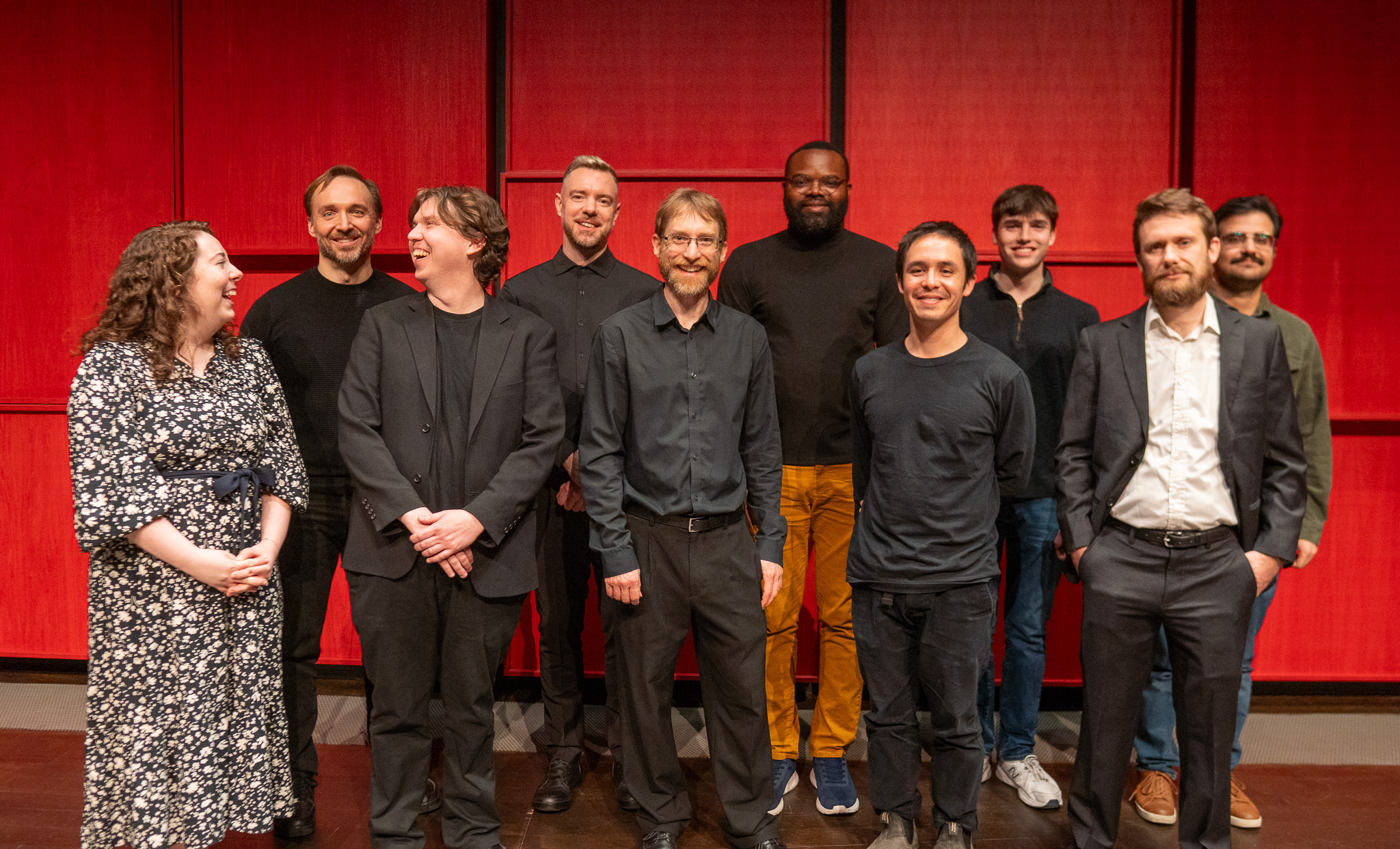
JACK Quartet II
Christopher Otto, violin
Austin Wulliman, violin
John Richards, viola
Jay Campbell, violoncello
Thursday, March 11, 2026 at 7:30p, Recital Hall
Program
Cold When It’s Hot Outside (2025) | Andrew WILSON |
De Tenebris, ad Lucem (2025) | Innocent OKECHUKWU |
Silicious Sinter (2025) | Blake CORDELL |
Navak (2025) | Ali KIANI |
Fragment 17 (Polytempic Canon 4:10:25) (2026) | Kyle QUARLES |
Dreamwalk (2026) | Lucy SHIRLEY |
Three Scenes for string quartet (2019/2025)
| Kevin SWENSON |
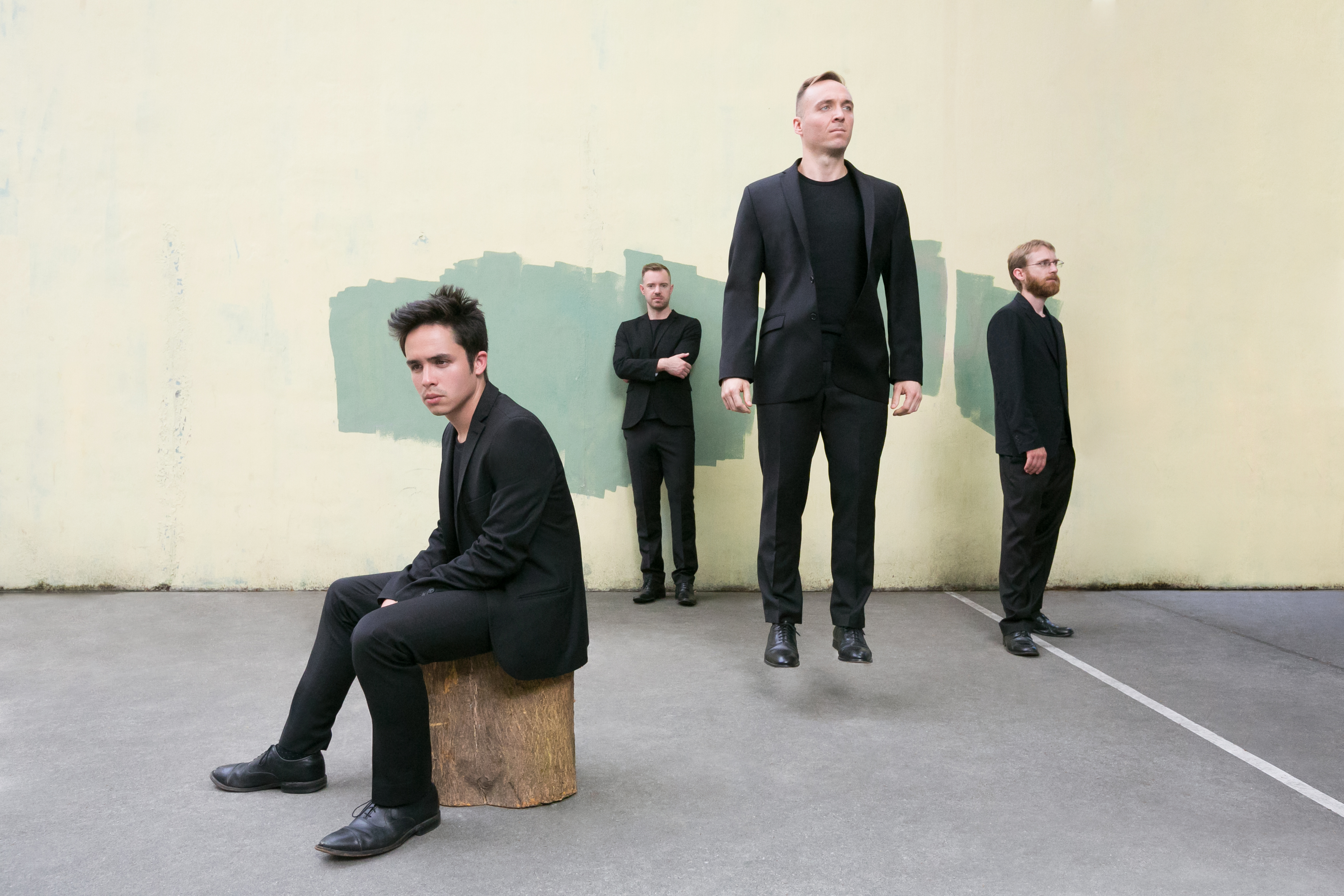
JACK Quartet Bio
Hailed by The New York Times as “our leading new-music foursome”, the JACK Quartet is one of the most acclaimed, renowned, and respected groups performing today. JACK has maintained an unwavering commitment to their mission of performing and commissioning new works, giving voice to underheard composers, and cultivating an ever-greater sense of openness toward contemporary classical music. The quartet was selected as Musical America’s 2018 “Ensemble of the Year”, named to WQXR’s “19 for 19 Artists to Watch”, and awarded an Avery Fisher Career Grant.
Through intimate relationships with today’s most creative voices, JACK embraces close collaboration with the composers they perform, leading to a radical embodiment of the technical, musical, and emotional aspects of their work. The quartet has worked with artists such as Julia Wolfe, George Lewis, Chaya Czernowin, Helmut Lachenmann, Caroline Shaw, and Simon Steen-Andersen. JACK’s all-access initiative, JACK Studio, commissions a selection of artists each year, who will receive money, workshop time, mentorship, and resources to develop new work to be performed and recorded by the quartet.
Committed to education, JACK is the Quartet in Residence at the Mannes School of Music, who host the JACK Frontiers Festival, a multi-faceted festival of contemporary music for string quartet. They also teach each summer at New Music on the Point, a contemporary chamber music festival in Vermont, and at the Banff Centre for Arts and Creativity. JACK has long-standing relationships with the University of Iowa String Quartet Residency Program, where they teach and collaborate with students each fall and spring, as well as with the Lucerne Festival Academy, of which the four members are all alumni. Additionally, the quartet collaborates with young composers at schools including Columbia University, Harvard University, New York University, Princeton University, and Stanford University.
Comprising violinists Christopher Otto and Austin Wulliman, violist John Pickford Richards, and cellist Jay Campbell, JACK operates as a nonprofit organization dedicated to the performance, commissioning, and appreciation of new string quartet music.
Program Notes & Composer Bios
Cold When It’s Hot Outside - This piece began with a melody in my head that, for some reason, lined up perfectly with the paradoxical phrase, 'I get cold when it’s hot outside'—hence the title. It features a jazzy groove and a few playful rhythms. I hope you enjoy it!
Andrew Wilson (b. 2007) is currently pursuing a Bachelor of Music in Piano Performance at the University of Iowa. He has a strong interest in composition and recently premiered an original concert band work with the Waukee High School Wind Symphony.
De Tenebris, ad Lucem — "From Darkness to Light" — for String Quartet, captures a deeply personal journey through despair , searching, and eventual renewal. This work charts the emotional landscape of the composer’s experience: a passage through pain, uncertainty , and inner struggle, underscored by a persistent longing for truth, light, and strength. The music reflects moments of hopelessness and wandering, yet always with an undercurrent of yearning — a reaching toward something greater . At its heart, this is a story of resilience: the belief that even in the depths of darkness, the promise of light remains. Through trial and tribulation, the composer holds fast to hope, ultimately seeking the joy and peace that follow endurance and growth.
Innocent Okechukwu (b. 1988), Nigerian composer and living in the USA, graduated from Longy School of Music (Cambridge, MA, USA) with a Master’s degree in Music Composition. Innocent, has over two hundred (200) compositions to his credit, which have been programmed in various parts of the world- Africa, Asia, Europe, and North & South America. Innocent has been described by People’s Daily (A National Newspaper in Nigeria) as “one who has appointment with greatness”.
Innocent is currently a Ph.D. Student of Composition at the University of Iowa. USA., where he studies with David Gompper. In early 2022, he published his first book – Musical Echoes, some collections of his original compositions, which are available for purchase on Amazon. He has also self-published two piano anthologies – The Voyage book 1 & 2. In August 2025, three works from his Piano Anthology was recently recorded by Navona records, a project called Arise & Shine, in conjunction with the Sphinx organization.
Silicious Sinter - Like the calcification of a rock, the smallest idea can harden into something infinitely more defined, detailed, and fortified. Jagged layer upon jagged layer, each one its own echo of a past eruption. Though the core gradually disappears over time, buried underneath an iterative shell, it remains a defining element of the sculpture that emerges. In this way, a musical idea can grow as if it were silica molded by the Earth's watery vents, both destined to grow, carried forward by their own potential.
Blake Cordell (b. 1995) is an Iowa-based composer, sound designer, and playwright. Previously, he spent a number of years in Chicago working as a lighting designer, sound designer, technical director, and playwright. His first musical, Inn-Dependent, won the Kennedy Center ACTF Region V New Play Award in 2015. His chamber composition Prismatic Thermophiles received 3rd place in the 2025 International Joseph Dorfman Composition Competition. Beyond his expansive portfolio of instrumental and theatrical music, Blake has written for a number of independent video games, animations, and films. Blake's music, across all mediums, emphasizes character, imagery, and narrative.
Navak takes its title from the Persian word for pitch. Embedded in the word is Nava, one of the principal dastgāhs of Iranian classical music. A dastgāh may be loosely compared to a maqam: both are modal systems, but a dastgāh functions not only as a scale but also as a collection of characteristic melodic models and short pieces that guide improvisation and composition.
This quartet explores the gestural possibilities of the Nava mode. The music begins quietly and almost neutrally, with an ethereal atmosphere that gradually unfolds. As the piece progresses, the sound world becomes more animated and energetic, eventually transforming into a more earthy and dance-like character.
The central rhythmic section draws inspiration from Kereshme, a rhythmic gushe (a short melodic-rhythmic piece within the dastgāh repertoire) in Persian traditional music. It is gradually transformed through rhythmic variation and development.
Ali Kiani (b. 1997) is an Iranian composer and pianist whose work is characterized by modal harmonies and cluster textures. His compositional approach explores unconventional yet idiomatic sound colors within Western classical instruments, seeking to expand their expressive possibilities while remaining grounded in performative practicality. He earned his bachelor’s degree in composition from the University of Art, Tehran, and later completed his master’s degree in music composition at Binghamton University, New York. He is currently pursuing a PhD in Composition at the University of Iowa. His works have been performed by ensembles such as Momenta Quartet, ModernMedieval, and Hub New Music.
Fragment 17 (Polytempic Canon 4:10:25) - Last year, I couldn't figure out how to write a true polytempic canon. The math was just too hard, so the rhythmic language of my last piece for JACK was more fluid. But this year I figured out a way to do it (with some inspiration from a blog post from Clifton Callander), so this one is truly polytempic. The first violin and viola form a canon at the 6th, and are in the same tempo layer. For every ten notes they play, the cello plays four, and the second violin plays twenty-five. The trick is designing the melody so that it forms stylistically valid harmonic combinations with itself which obey these polyrhythms. The melodic language is loosely medieval, and the piece moves through various detuned approximations of a naive Pythagorean intonation that I hope gives an impression that the dead courtiers of Avignon circa 1380 have been resurrected in front of your eyes.
Composer Kyle Quarles (b. 1989) received his bachelor's degrees in composition and guitar performance from the Eastman School of Music in 2012, his master's in composition from the New England Conservatory in 2021, and is currently a PhD candidate in composition at the University of Iowa. His music often uses techniques from mathematics and computer science to ingest and re-cast musical languages of the ancient past. Highlights from 2025 include performances at the International Computer Music Festival in Boston, and research presented at the Society for Music Theory in Minneapolis. Also a professional chorister, his recordings with the Christ Church Schola Cantorum appear on Loft Recordings, and he currently sings with Trinity Episcopal in Iowa City. More information can be found on kylequarles.com.
Dreamwalk emulates the vivid colors of a recurring dream and the bodily sensations of running in your sleep. Churning, recurring figures evoke the feeling of rushing in place, swirling around like a sort of musical somnambulism in the fragmented framework of active sleep.
Lucy Shirley (b. 1997) is a composer interested in language and memory. Her works are polystylistic and playful, often focusing on aspects of the human voice. Shirley’s earliest musical influences come from long car rides as a kid listening to her mom’s mixtapes of showtunes and classic Americana, and she frequently finds herself incorporating aspects of theatricality and folk melody into her current practice. She has worked with artists such as JACK Quartet, the mdi ensemble, LIGAMENT, The Crossing, The Imani Winds, Mammoth Trio, and Carrie Koffman, and her music has been featured at festivals such as June in Buffalo, the Norfolk New Music Workshop, the Napoleon Electronic Music Festival, the World Saxophone Congress, the University of Georgia's New Music Festival, and HighSCORE Festival in Pavia, Italy. Shirley’s awards include selection in IAWM’s 2024 Call for Scores, SOLI Chamber Ensemble’s 30x30x30 Project, and a 2022 ASCAP Morton Gould Young Composer Award.
Three Scenes - Memories about one’s own pieces are a strange thing. Three Scenes is a substantial revision of a string quartet I composed in 2019 that was read at Syracuse University at that time. My memory is that the reading did not go particularly well, and I therefore never felt happy with the work although I felt that it had some unrealized potential. Three Scenes is my attempt to realize that potential by resurrecting and improving the piece after nearly seven more years of study and experience.
As the title suggests, the piece is comprised of three movements. The first movement, Overture, introduces the basic interval series that governs the pitched materials I composed throughout the work. The overture presents a series of relatively brief moments in many different characters, one after the other, foreshadowing future moments in the later two movements. The Recitative and Aria that follows presents an introduction featuring speech-like rhythms that gives way to a passionate and fiery aria for the first violin. The Finale features a contemplative viola solo that is continually interrupted by the rest of the ensemble.
Kevin Swenson (b. 1995) is a composer and performer of acoustic and electronic music from Yuba City, California. His recent work explores musical materials derived through diverse techniques such as digital image processing, fractal geometry, Pythagorean numerology, and just intonation tuning. His compositions have been featured in music festivals throughout the US including the PdMaxCon25~ conference, University of Oklahoma’s inner sOUndscapes concert series, the Napoleon Electronic Music Festival, the Splice Institute, the Cazenovia Counterpoint Festival, and the 28/78 New Music Festival, as well as at the KlexosLab New Music Festival in Spain. He also gave a presentation about his ongoing computational music theory project involving Stravinsky’s serial period music at the 18th International Conference on Music Perception and Cognition in São Paulo Brazil in the summer of 2025. He is currently an ABD Ph.D. Candidate in Music Composition at the University of Iowa. In addition to his studies, he works as the Audio Lab Teaching Assistant for Iowa’s Department of Dance.