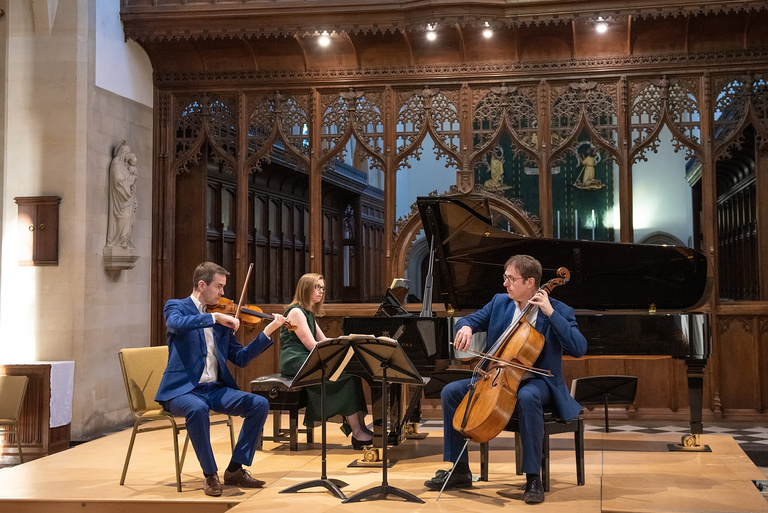
The Fidelio Trio
Darragh Morgan, violin
Tim Gill, violoncello
Mary Dullea, piano
Wednesday, October 28, 2026 at 7:30p, Recital Hall
Program
Bulb (2020) | Donnacha DENNEHY (b. 1970) |
Piano Trio (2018) | Louis KARCHIN (b. 1951) |
short intermission
Piano Trio No. 2 ("Tau") (2026) | David GOMPPER (b. 1954) |
La Mer (1905)I. De l'aube à midi sur la mer | Claude DEBUSSY (1862-1918) |
The Fidelio Trio
‘The Fidelio Trio, a London-based Irish-peopled ensemble whom I and my composer friends hold close to sainthood for their determination to perform new works just as often as they can.’ Dame Judith Weir
The …’virtuosic Fidelio Trio’… (Sunday Times) are Darragh Morgan, violin, Tim Gill, cello and Mary Dullea, piano. Shortlisted for a 2016 Royal Philharmonic Society Music Award and awarded Gramophone Album of the Year, they broadcast regularly on BBC Radio 3, RTÉ Lyric FM, WQXR, ABC and have been featured on a Sky Arts documentary.
Since their debut at London’s Southbank Centre, Fidelio Trio have regularly appeared at the Wigmore Hall and Kings Place, at festivals including Spitalfields, Cheltenham, St. Magnus, Three Choirs, Newbury Spring, Proms at St Jude’s and Huddersfield Contemporary Music Festival. In Ireland they regularly perform at National Concert Hall, Dublin, and internationally at Shanghai Oriental Arts Center, Beijing Modern Music Festival, Hong Kong Chamber Music Society, Singapore, Bangkok, Porto, Paris, Venice, Florence, Johannesburg, Harare, New York City, San Francisco and Boston.
Recent appearances include Dark Music Days Iceland, an extensive USA tours including National Sawdust Brooklyn, Washington Square Contemporary Music Society, ‘Music on the Edge’ Pittsburgh, Cayman International Arts Festival, Les Jardins Musicaux Neuchatel as well as regular European concert and festival performances. 2026-27 season sees a further USA tour, a celebrity recital at Wuxi Symphony Hall, China, Bang on a Can Long Play Festival, Presteigne Festival and an album release of recent Fidelio Trio commissions by Anna Clyne, Richard Causton (shortlisted for 2026 RPS chamber ensemble composition), and David Fennessy for NMC.
Their extensive discography includes a Gramophone Magazine Editor’s Choice and Critics’ Choice 2022 of Chamber Music by E J Moeran, a composer with whom they are closely associated and the release of premiere recordings on Mode Records of music by Gerald Barry. Other significant releases include 2 French albums of Ravel and Saint-Saëns, Fauré, Chausson and Satie on Resonus Classics; Philip Glass Head On & Pendulum on Orange Mountain; Korngold and Schoenberg (Verklärte Nacht arr. Steuermann) for Naxos; the complete Michael Nyman Piano Trios for MN Records; multiple releases on NMC, Delphian Records; portrait CDs of composers such as Xiaogang Ye, Piers Hellawell and Michael Zev Gordon. Their previous release of French Piano Trios for Resonus was also a Gramophone Magazine Editor’s Choice.
The Fidelio Trio have given masterclasses at Peabody Conservatory, Curtis Institute, NYU, Central Conservatory Beijing, and Stellenbosch Conservatorium South Africa. They have been artists-in-residence at University of Iowa, St. Patrick’s College Dublin City University, University of Illinois at Champaign-Urbana, the State University of New York, SUNY and Tufts University, Boston.
Composers that the Trio have premiered music by include Anna Clyne, Toshio Hosokawa, Charles Wuorinen, Johannes Maria Staud, Michael Nyman, Gerald Barry, Donnacha Dennehy, Mícheál Ó Súilleabháin, Joe Cutler, Ann Cleare, Judith Weir, Piers Hellawell, David Fennessy, Kevin Volans. Gavin Higgins, Linda Buckley, Tom Coult, John Harbison, Sam Perkin, Amanda Feery, Finola Merivale, Emma O Halloran, Claudia Molitor, Shirley Thompson, Richard Baker, Robert Saxton, Simon Bainbridge and Alexander Goehr.
Artists the Fidelio Trio have performed with include Nicholas Daniel (oboe), Michael Collins and Julian Bliss (clarinet), Richard Watkins (horn), Rachel Roberts (viola), author Alexander McCall Smith, T.S. Eliot prizewinning poet Sinéad Morrissey and actor Adrian Dunbar. They have developed work in collaboration with Rambert Dance Company and feature in the film of Sir Kenneth MacMillan’s Sea of Troubles with Yorke Dance Project.
Fidelio Trio often perform Beethoven’s Triple Concerto including with KZN Philharmonic Orchestra South Africa, National Symphony Orchestra of Ireland, and recently at the Sheldonian Theatre Oxford and Ely Cathedral. They are Artistic Directors of their annual Winter Chamber Music Festival at Belvedere House, Dublin City University.
Program notes and Composers Biographies
| Donnacha Dennehy "Bulb" Bulb was commissioned by the Fidelio Trio with funds provided by the Arts Council of Ireland. It takes as its basis the overtone series built on a very low G, and it grows outwards from a small band of these overtones by means of pulsing glissandi (in the violin and cello). Well in fact these pulsing glissandi are for the most part made of two notes (one moving, the other providing a reference drone by its repetitions). By the end, the violin and piano have swapped registral places. It’s an artificial vandalism of a natural phenomenon (the overtone series), like the way electric lighting is of the visual spectrum, or the paintings of Bridget Riley are of various natural perceptions. (note by the composer) |
| Louis Karchin – Piano Trio My Trio for violin, cello, and piano was composed in 2018 during a period when chamber music composition was an important focus for my writing. I was well aware of the legacy of the genre, rich in masterpieces, and its traditions certainly influenced my thinking. In fact, the opening upward-sweeping motif of theTrio was inspired by the opening of an older work of slightly expanded instrumentation, Robert Schumann’s famous E flat major Piano Quintet. (At the work’s premiere in Dublin, Ireland, the Fidelio Trio took note of this bridge by programming the Schumannn alongside my own work, adding the necessary extra players). The first movement of the Trio is in a traditional Sonata-Allegro form, with an exposition containing several themes, the second one, a leaping cello solo that explores the extreme registers of the instrument. The more contemplative second movement has two distinct themes, and these are varied and expanded as the movement progresses; at one point, both combine in a direct and audible way. The third movement is a galloping finale, and is cast as a modified Rondo. The Trio lasts about 24 minutes. (note by the composer) |
David Gompper - Piano Trio No. 2 (Tau) At the heart of the composition is a rigorous generative engine. Much of the core melodic and harmonic material is derived directly from the cumulative decimal digits of pi. By subjecting successive sequences of these digits (14, 141, 1415, and so on) to mod-12 pitch-class operations, the music organically maps out its expressive contours. This mathematical translation yields a striking sonic landscape characterized by shifting melodic lines and layered pairs of perfect fifths spaced a major second apart, turning cold ratios into a musical journey. (note by the composer) |
| Claude Debussy - La Mer To arrange La Mer for piano trio was one of the biggest challenges I’ve encountered. The temptation was to represent every note from Debussy’s score, but in order to do that (in any case nigh on impossible) all three musicians would have had to be playing all the time, which could have led to an unchanging, dense texture. I decided instead to look at the piano trio itself as a medium – particularly works such as the Ravel – and reinvent Debussy’s orchestral score with the piano trio in mind. I needed to create light and shade, and subtleties of color. This meant exploring what strings and piano can do in terms of texture, and concentrating on idiomatic and natural techniques. This led to use of harmonics, mutes, bow position – such as sul ponticello (a glassy sound made by playing very near the bridge) – and various doublings between piano and strings, using unisons to create new ‘instruments’ – like mixing blue and yellow to make green. Once I’d completed the score, I worked with the players, who often suggested feats of virtuosity I hadn’t thought possible, thereby opening up new possibilities previously discounted. It has been an immensely satisfying experience to collaborate on re-creating this iconic score. (note by the arranger) |