CNM Ensemble Concert I
Sunday, October 11, 2026 at 7:30p in the Concert Hall
featuring guest clarinetist
Michael Norsworthy
Program
Tria ex uno (sextett nach Josquin Desprez (2001)I. Tria ex uno I | Georg Friedrich HAAS (b. 1953) |
Chaosupei Gao, flute |
Alchymia for clarinet quintet (2021)I. A Sea-Change (…those are pearls…) | Thomas ADÉS (b. 1971) |
| Michael Norsworthy, clarinet Alexandre da Silva Negrao, violin I Kang-In Han, violin II Sirenia Garcia, viola Christopher Mendez, violoncello |
intermission
Cristales De Tiempo (2025)for small ensemble, in five movements | Santiago SANTERO (b. 1962) |
| Chaosupei Gao, flute Kennth Northcutt, clarinet Sam Shaner, percussion John Thomas Morris, piano Alexandre da Silva Negrao, violin Christopher Mendez, violoncello David Gompper, conductor |
Solstice Ritual-Homage to Varèse and Ravel (for 14 virtuosi) (2025) | Augusta Read THOMAS (b. 1964) |
| Chaosupei Gao, flute Lorena Coronado, oboe Kenneth Northcutt, clarinet Erin Freund, harp John Thomas Morris, piano Henrique Rabelo, celeste Nathan Ortiz, Jenna Zimmerman, Sam Shaner, Shaun Everson, percussion Alexandre da Silva Negrao, violin I Kang-In Han, violin II Sirenia Garcia, viola Christopher Mendez, violoncello David Gompper, conductor |
Performer biography
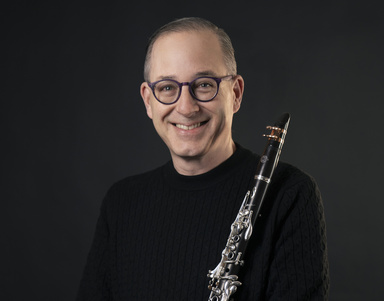
Grammy award winner, Michael Norsworthy, has been heard in major concert halls around the globe and is a recognized educator, technician and consultant. His personal approach to presenting, developing and nurturing the artistic possibilities around him have resulted in partnerships with world class musical collaborators, schools of music and manufacturers. As soloist with numerous orchestras around the USA and abroad, as a captivating recitalist and chamber music performer and as one of the most celebrated champions of the modern repertoire having premiered over 150 new works at such venues as Carnegie Hall, Vienna’s Musikverein, Moscow’s Tchaikovsky Hall, The Casals Festival and the Aspen Festival, Norsworthy has defied categorization, dazzling critics and audiences alike. His discography, numbering over 80 releases, can he heard on Naxos, Mode, Gasparo, Albany, New Focus, New World, BMOP/sound, ECM, Navona, Nonesuch, Canteloupe and Cauchemar records. He is the owner of New York City Woodwinds and is a proud performing artist for Selmer Paris and Vandoren. |
Program Notes
Georg Friedrich Haas (b. 1953) Georg Friedrich Haas was born in Graz on August 16, 1953. Between 1972 and 1979 he studied composition at the University for Music and Performing Arts Graz, with Ivan Eröd and Gösta Neuwirth, and later with Friedrich Cerha in Vienna. Haas taught composition at the Kunstuniversität Graz and the Musikakademie Basel, and in 2013 was appointed Professor of Music at New York’s Columbia University. |
Thomas Adès Born in London in 1971, Thomas Adès studied piano at the Guildhall School of Music & Drama, and read music at King’s College, Cambridge. A prodigious composer, conductor and pianist, Adès was described by the New York Times in 2007 as one of today’s ‘most accomplished overall musicians.’ |
Santiago Santero I wrote Time Crystals in 2025. The work was premiered that same year in Buenos Aires. It is made up of five pieces for a small ensemble of six instrumentalists. The title comes from a scientific idea that I followed with some interest for a while: so-called time crystals. In very broad terms, they can be thought of as physical systems that, much like an ordinary crystal -which repeats its structure in space- repeat their behavior periodically in time. What particularly interested me was that image: that of crystallized time. A time that, rather than moving forward, seems to remain suspended; a time that does not necessarily project a musical or sonic idea ahead, but instead turns back on itself, repeats, transforms, and reappears. Inevitably, this idea finds certain echoes in the history of music. I think above all of K. Stockhausen’s “moment form” and, further back, toward the beginning of the twentieth century, of certain works by Igor Stravinsky. In different ways, they embody a conception of time that moves away from the idea of musical expression as necessarily oriented toward a point of arrival. The five pieces are strongly contrasted with one another. And yet, behind this diversity lies the same underlying concern: a question about time. Not so much time as an abstract concept, but rather our experience of it: how we imagine it, how we construct it, and, above all, how we perceive it while listening. In the poem “Otro poema de los Dones,” Jorge Luis Borges writes, in its final line: “For music, mysterious form of time.” Time Crystals was born out of that attempt: to stop time for an instant, to fragment it, to make it repeat, and to try to perceive what happens when time ceases to be merely that which passes. Santiago Santero (Buenos Aires, 1962) is a prominent Argentine composer, conductor, and educator with a distinguished career dedicated to the creation, performance, and promotion of contemporary music. As both a conductor and composer, he has led prestigious ensembles across the Americas and Europe, including the National Symphony Orchestra of Argentina. His musical career has taken him to stages throughout Latin America, the United States, and Europe. His works have been performed by renowned international soloists and contemporary music ensembles, such as Ensamble XXI, Ensamble Sudem, Quinteto Sonorama, Ensamble Tropi, and Compañía Oblicua (Argentina); Piano Circus (London); soloists from the Psaphaa Ensemble (UK); Antidogma Musica (Turin, Italy); Ensemble Modelo 62 (The Hague, Netherlands); Opera Nova (Zurich, Switzerland); Ensemble Recherche (Germany); Ensemble Écoute (France); as well as the National Symphony Orchestra and the Permanent Orchestra of the Teatro Colón in Buenos Aires. In the academic field, he maintains an active teaching career as a Full Professor of Music Composition at the Department of Musical and Sonic Arts of the National University of the Arts (UNA). Since 2009, he has also served as the Music Director of the UNA's Contemporary Music Ensemble, leading an intensive program of both pedagogical development and concert performances. |
Augusta Read Thomas The music of Augusta Read Thomas (b. 1964 in New York) is nuanced, majestic, elegant, capricious, lyrical, and colorful — "it is boldly considered music that celebrates the sound of the instruments and reaffirms the vitality of orchestral music" (Philadelphia Inquirer).
|